



The "Year-End Test" for Door and Window Sealing
What is the first thing you do after a sandstorm? Before opening the windows to air out the room, take a look at the windowsill—the fine sand accumulated there serves as a "report card" left by the storm on your door and window sealing system. These seemingly harmless grains of sand bombard window frames and weatherstripping at speeds of tens of kilometers per hour, ruthlessly exposing the most vulnerable points of the seal.
The damage caused by sand and dust is abrasive in nature. Fine sand particles are incredibly invasive; once they work their way into the interlocking gaps of sliding windows, they repeatedly grind against the rubber seals and pile weatherstripping every time the window is opened or closed, accelerating aging, cracking, and the loss of elasticity. When moving parts like tracks and rollers become jammed with sand, operating resistance increases, as does noise. Over time, gaps that were once tightly sealed widen due to this abrasion, leading to a cascade of issues: dust infiltration, water leakage, and the loss of conditioned air.
Standard door and window sealing designs often struggle to withstand severe sandstorm conditions where PM10 levels exceed 300 μg/m³. While a single layer of pile weatherstripping may suffice under normal conditions, it fails against a sandstorm; fine particles can easily penetrate the gaps, causing indoor particulate concentrations to skyrocket—potentially nearing outdoor levels. To truly withstand sandstorms, a structural "triple-seal" design is required.
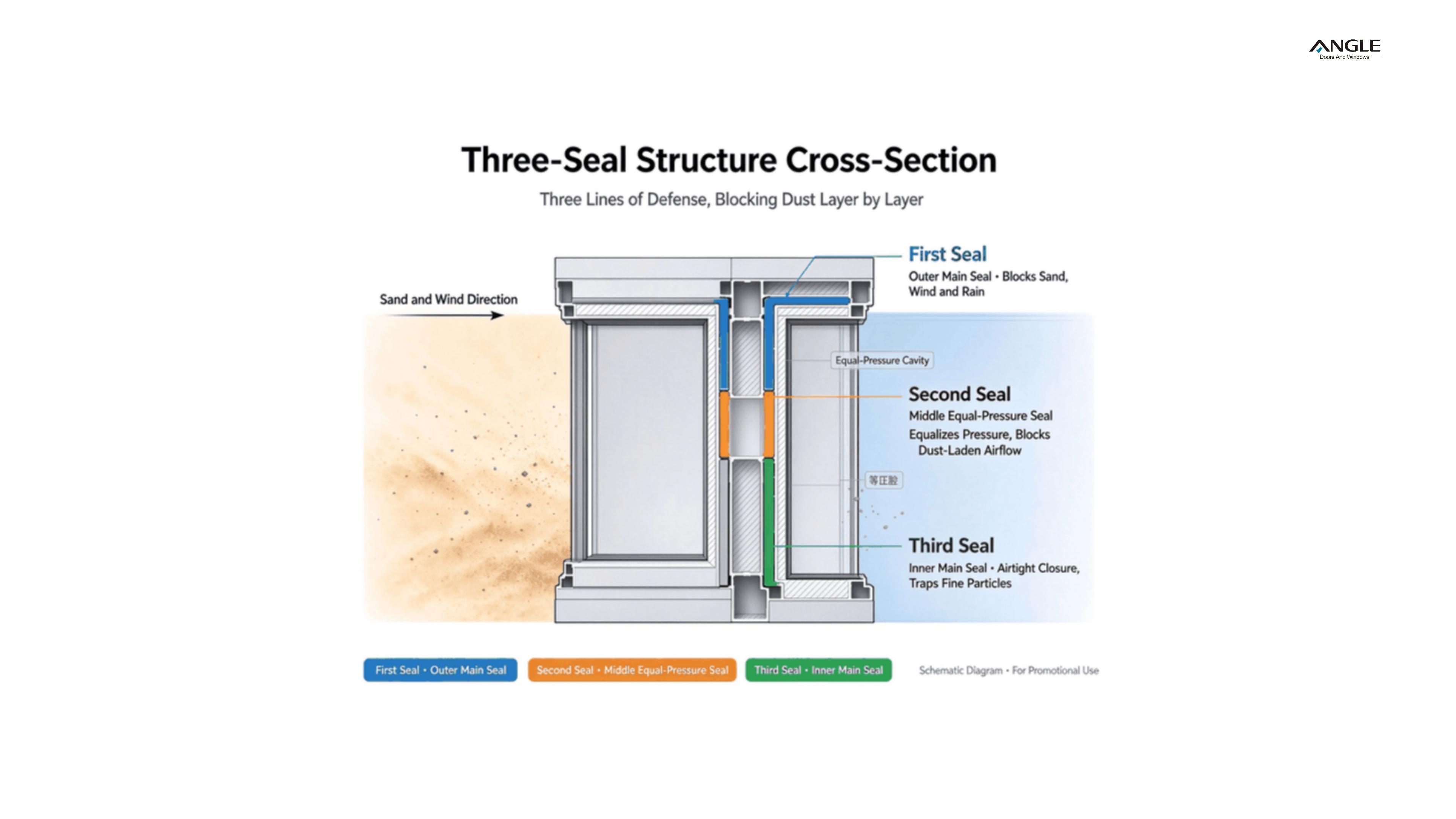
Looking at this cross-section, the first seal is positioned on the exterior side, acting as a "gatekeeper" to block wind, sand, and rain. The second seal sits in the middle, forming a pressure-equalization chamber with the profile; by balancing internal and external air pressures, it disrupts the flow paths of dust-laden air. The third seal guards the interior side, ensuring airtightness and intercepting any fine particles that managed to slip past the previous barriers. Each of the three seals performs a specific function, creating a layered defense system that progressively "disarms" the dust and sand before they can enter the room.
The differences in sealing structures are most clearly evident during dusty weather.
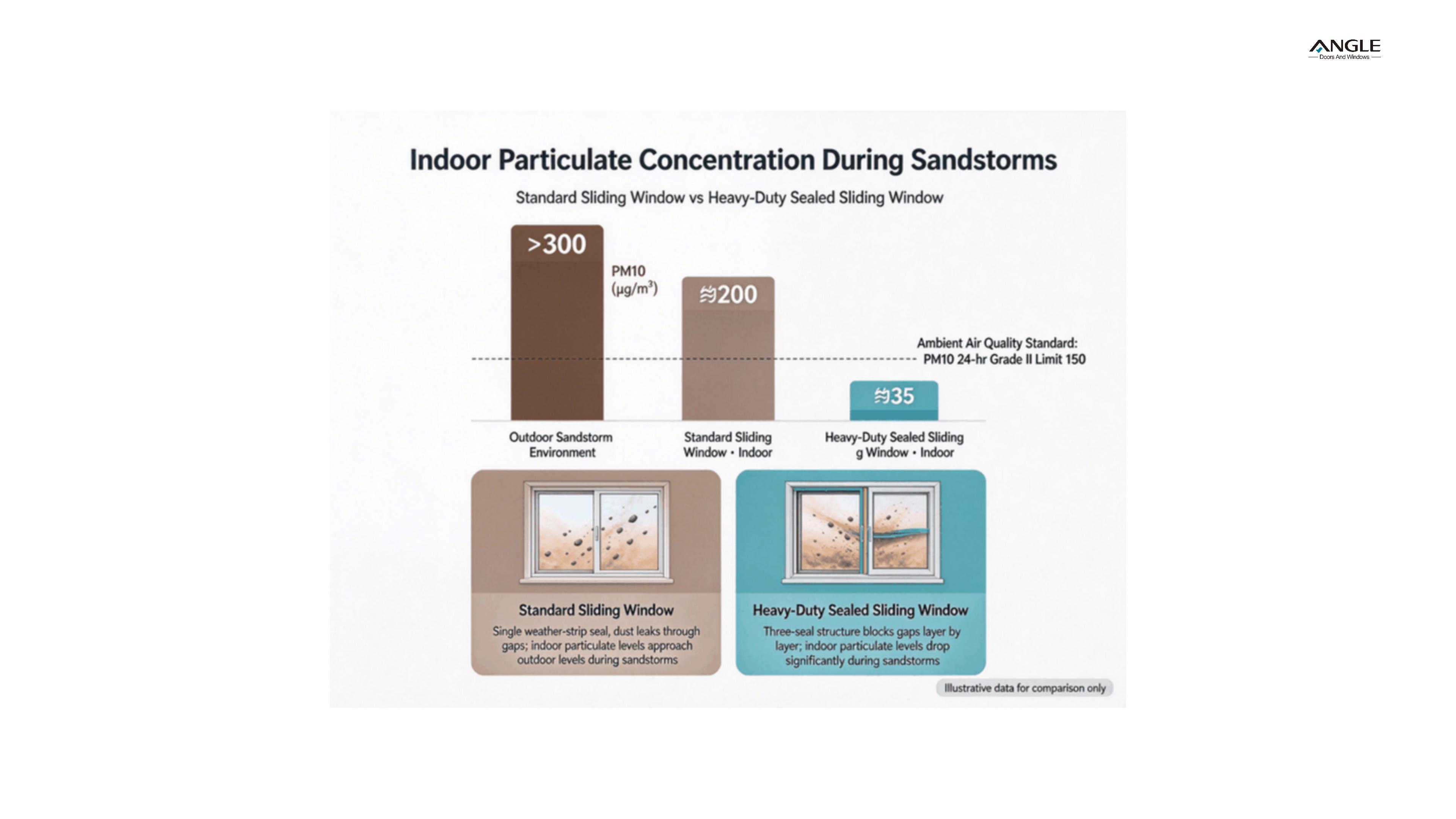
Comparative data (illustrative values) in the infographic show that when outdoor PM10 levels exceed 300 μg/m³ due to dust, the indoor concentration with standard sliding windows reaches approximately 200 μg/m³—approaching outdoor levels and significantly exceeding the Grade II daily limit of 150 μg/m³ set by the *Ambient Air Quality Standards*. In contrast, heavy-duty sliding windows featuring triple-seal technology can reduce indoor concentrations to around 35 μg/m³, performing far better than the standard limit. This performance gap stems from the combined effectiveness of the sealing layers, the material of the weatherstripping, and the structural design of the window profiles.
There is wind and sand every year, and the doors and windows are opened every day. Choosing a heavy-duty sealed sliding window with a complete sealing structure and reliable rubber strip material can guarantee quietness and heat preservation in normal times, and act as an invisible "health barrier" on sandy and dusty days. One less grain of sand on the windowsill means more peace of mind in the room.